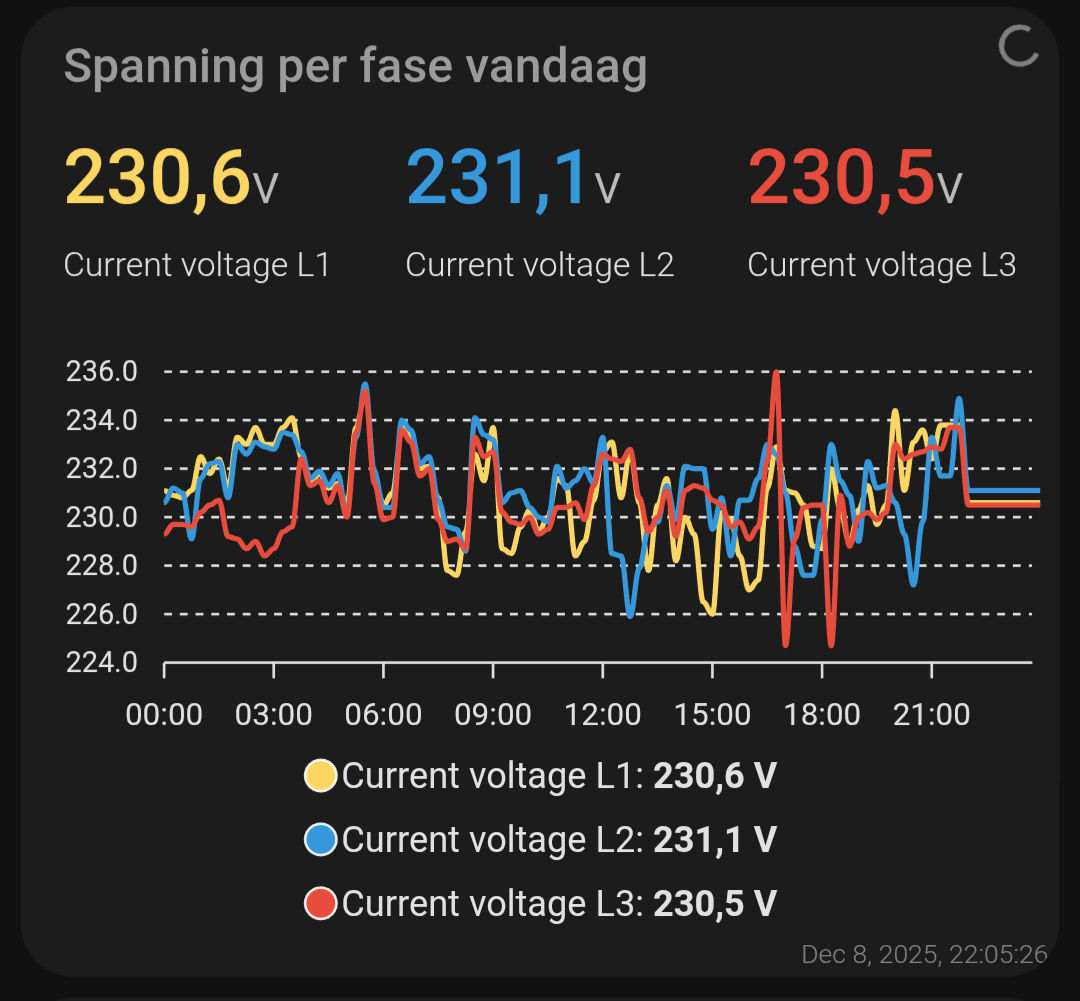
I had the idea to use the voltages that are reported by my energy meter installed by the supplier, instead of using the derived three-phase option.
That way I have the correct voltages for every phase of my 3-phase wiring.
So I connected a bunch of CT’s and set up all the outputs to be outputting amps to my home assistant.
In home assistant i then multiply the current sensor with the correct phase voltage to become the Wattage of that CT.
I have noticed however when I compair the native power entity provided by Iotawatt with my calculated power sensor, that my sensors always report a higher wattage.
Am I missing something here?
My guess is that some ct’s output a small current even when the devices on that circuit are switched off.
Any help would be appriciated in whats happening here
IoTaWatt will give you VA if you want to compare apples to apples. That said, I can’t imagine that the granularity of HA calculations would be very accurate anyway.
Why are you doing this? Does your meter report significantly different (>1%) kWh and Watts than the IoTaWatt? Probably 99% of IoTaWatt three-phase installs use derived reference with satisfactory results. Over the years I’ve had academic skepticism about derived three-phase reference, but I can’t recall anyone ever presenting an argument based on empirical evidence. Personally I instrumented an industrial three-phase service and measured the MWh over weeks and months using both direct and derived voltages and the results just do not show any significant differences.
Another point of view might be that while folks dwell on derived three-phase, the thousands of split-phase installations throughout North America are actually using the same derived reference technology. IoTaWatt phase shifts the L1 voltage by 180° (by negating it) as a reference for all of the L2 circuits. The only difference is that three-phase derived shifts by 120°. It’s possible to use direct reference by adding an L2 VT, but nobody does it as it just doesn’t yield any significant improvement over the typical 1% or better accuracy.
They don’t. There may be some small mA recorded but that is the result of electronic noise.
They mostly lie right on top of each other. L3 goes off the reservation for maybe 2-3 hrs (10% of the time) and then by around 4 volts (1.7%). The rest of the time they are typically within less than a volt (0.5%). The current voltages shown are all within 0.26% of each other.