Yes, they are.
For each measurement, IoTaWatt collects sample pairs of voltage and current for one AC cycle, defined as starting at the voltage zero crossing and ending after two more zero crossings. To compute real power (Watts) is the average of the products of voltage and current of each sample pair. IoTaWatt samples each AC cycle about 640 times at 60Hz. This is the way every digital power monitor I’ve seen works. So power factor is a product of the fundamental measurements, rather than a fundamental measurement itself.
Each time a channel is sampled (two or more times per second), the measurements are added to individual watt-millisecond and VA-millisecond accumulators. Every 5 seconds, those values are essentially turned into watts and VA by dividing the accumulated totals by ~5000ms. So regardless of the regularity of the sampling, the weighted average is a good integration of the power over the 5 second period.
What you see in the status display is an average of all the frequency reading over the last second. It works perfectly for single phase, but when there are more than one voltage channels, it is sort of an average. This is where the new units output come in. If you output Hz for a specific voltage channel, you will get the frequency of that channel only.
Interesting that you have both three phase methods enabled in the same device. If I had a readily accessible three phase service, I would do the same, using two CTs on each of the phases 2 and 3 with one assigned to the derived phase reference and the other to the direct VT reference, and I would compare the results over time. The IoTaWatt can do both derived and direct reference at the same time.
Now that you have said it, I went back and looked at your post of July 12:
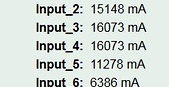
I can see that 3 and 4 are the same. The answer to the question is no, I don’t believe that could have anything to do with the problem on input 6.
As an aside, the current you are computing is probably pretty close to the rms current because your PF is near unity. But it would be off by an amount proportional to the PF variation from unity, and also by any difference in voltage between phase B and C from A for those phases. If you switch to reporting Amps in the output, you will not need to divide and scale, and the reported value will be the true RMS Amps - for all phases.