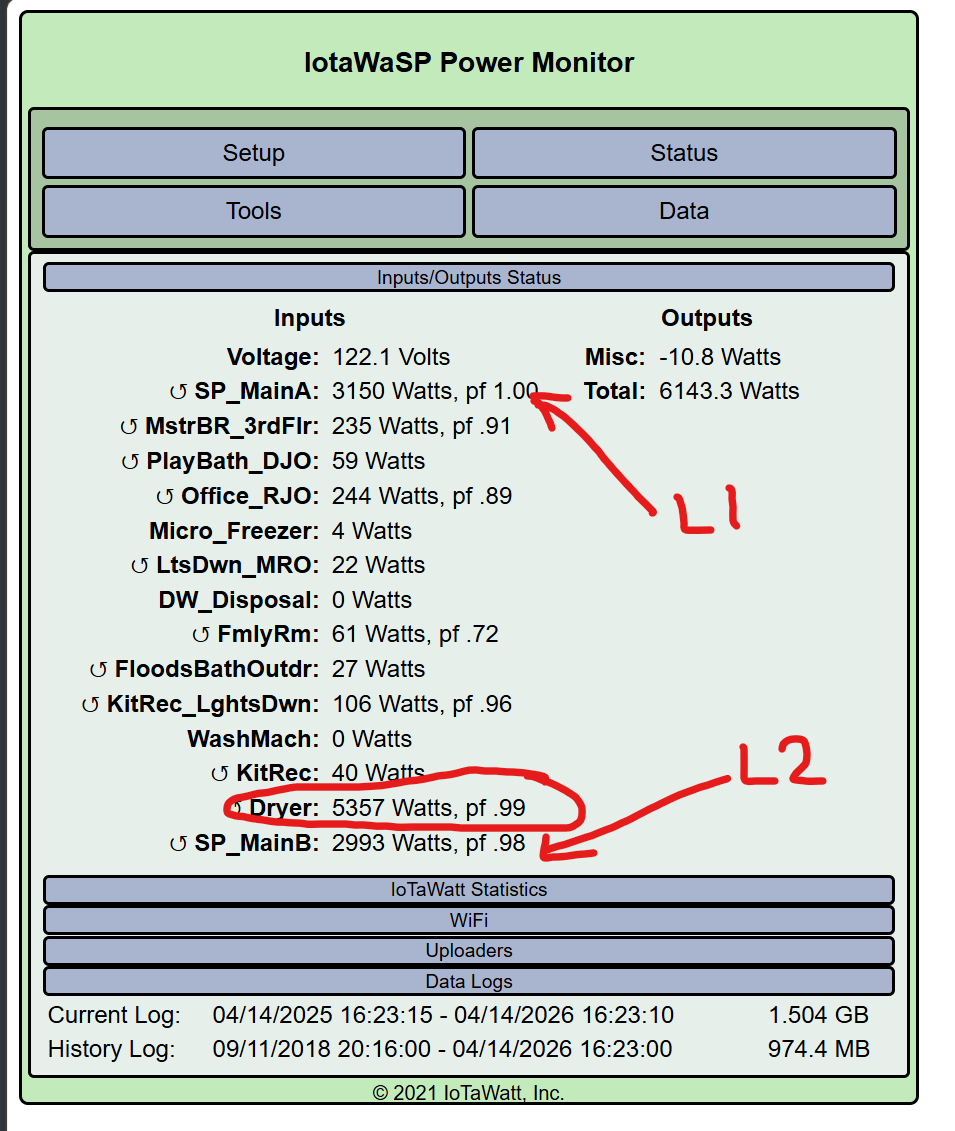
I happened to be looking at the real-time status update screen on my IoTaWatt yesterday. I noticed a very large imbalance between the two legs of my USA 240VAC split phase. The difference was about 2kW which seemed odd to me. So I dug a little deeperand saw that my Samsung electric clothes dryer was running, and it was the main consumer of power. However, since the heating element in the dryer is 240VAC, I would have expected to see a similar amount of power usage on both legs of my power. It turns out that my neutral wire for that circuit, which should only carry the difference caused by the 120VAC motor and electronic controls, was carrying ~19.5A (verified via a clamp on meter.)
After a little online research, I discovered that the heating element in these Samsung dryers can sag and make contact with the chassis. Since my dryer outlet is only a 3-prong style, the chassis is bonded to the neutral wire as per Samsung’s instructions. This explains how the current is getting on the neutral wire as well as why my wife says it is taking a lot longer to dry the clothes than it used to. The dryer should be drawing up to 5300W while running, but is only drawing about 2000W due to the heating coil being shorted to chassis. It most likely broke and sagged to where it is making contact with the chassis, so less than half the coil is actually heating up.
I have ordered a bunch of parts to refurb the 11 year old dryer, as it still works pretty well. The parts are cheap. I am also going to change the dryer outlet to a 4-prong style and will replace the dryer cord accordingly. This should make for a safer setup in the long run.
Just wanted to say thanks to @overeasy for making such a great product! I would have never known about this situation were it not for IoTaWatt!
2 Likes
Nice catch. While IoTaWatt is a good tool to diagnose problems like this, it’s not like it sends you a message that your dryer might have a short to neutral. I think very few users would be able to track that down. Nice job and thanks for explaining here for everyone to see.
1 Like
Replaced the failed heater coil. Dryer is now properly pulling >5000W total, and both legs of my electrical system are carrying the load.
The repair was pretty straightforward. I also replaced my dryer’s drum belt, roller support wheels, and tensioner pully. The pully was seized up, and the old belt had worn through the plastic pulley. I am amazed the belt did not shred.
No luck on changing over to a 4 wire outlet and power cord, though. Looks like when my house was built, they saved a few pennies by using 10/3 Romex without a ground wire. Just Black, Red, and White wires. Oh well! I should create an automatic notification if my IoTaWatt reports a large power usage discrepency between L1 and L2. This would help me find this issue if it were to happen again in the future.
Again, Thank You @overeasy for creating and sharing the IoTaWatt with the world! Such a great product.
My dryer is the same (old Maytag Neptune). The difference is that mine has a ground wire connected to the copper water pipes. I always felt comfortable with that setup not knowing that neutral was bonded to the cabinet ground. Now I’m not clear on why that is the case. Two things:
If for some reason the neutral were to break between the street and the dryer, any short such as you had could put the whole cabinet at a high voltage.
The code does not allow bonding of ground and neutral beyond the entrance panel and this seems to do the same thing. If I had a GFCI breaker on the dryer, I think it would pop.
1 Like